Worried about carrying camera gear on the tube at busy times? Pack light, keep your kit close and know TfL’s photography rules before you travel. Here is what the sources actually say.
This guide is one part of a wider look at the photography community london and the practical questions its members face.
| Item | Value |
|---|---|
| Weekday windows when TfL permits filming and photography | Monday to Friday 10:00-15:30 and 20:00-23:00 |
| Crew on an in-service train in Zones 1-2 (occasional) | Up to 5, with lightweight handheld equipment only |
| Notice TfL generally requires for a permit | 3 weeks (15 working days) |
| Minimum public liability insurance for a permit | £10m |
| Flash photography (TfL guidance of 14 April 2016) | Not permitted unless using an exclusive area |
| Tripods (TfL guidance of 14 April 2016) | At operational staff’s discretion; not on platforms or near escalators |
The figures come from TfL’s guide to filming or taking photos on the TfL network and, for flash and tripods, from TfL’s guidance as published by WiredGov on 14 April 2016. Rules and prices can change, so check the source before you rely on them.
What TfL’s photography rules actually cover
TfL’s guide sets out the costs, conditions and permissions for filming or photography across the Tube, London Overground, DLR and Elizabeth line, plus the London Cable Car, trams, piers and Victoria Coach Station. It is written for shoots and paid content, so it does not answer every question for someone with a camera bag on a commute.
The guide draws a line between commercial and organic content. In TfL’s wording, a commercial filming permit is required before filming any commercial or promotional content on the network, while organic content is permitted if it does not promote a product or service.
Older guidance is blunter. TfL’s text, published by WiredGov on 14 April 2016, said you must ask permission ahead of time from the TfL Film Office to film or take photographs on the network. Treat that as dated background and check with TfL what applies to you now.
Packing light for a crowded carriage
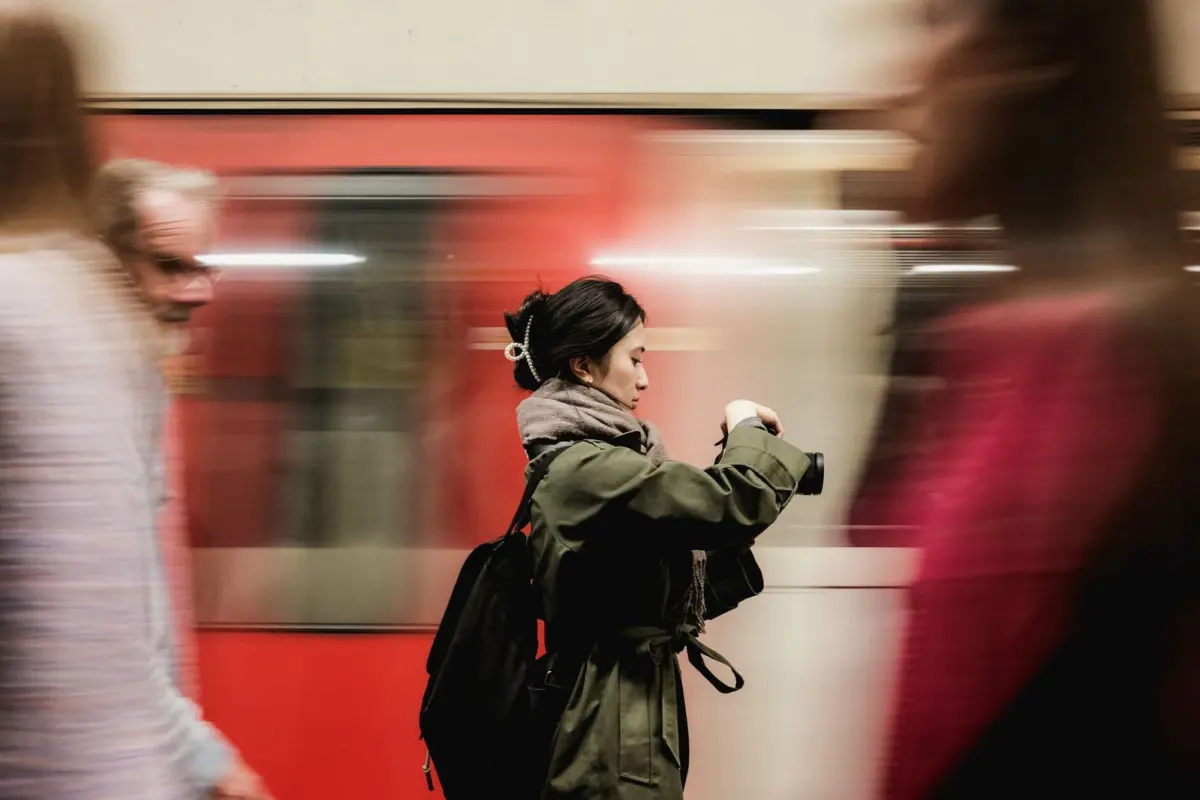
TfL says filming on a train in service is inherently difficult because of passenger demand, and that journeys to, through and from central London are generally the busiest, according to its permit guide. Your own commute faces the same crowds, so the kit you carry matters.
For permitted shoots, the same guide mentions occasionally allowing up to 5 crew in Zones 1-2 with lightweight handheld equipment only. That makes a handy benchmark for what counts as sensible kit in a carriage.
These habits are suggestions, not TfL rules:
- Take one body and the lens you will actually use.
- Leave the tripod and any lighting at home.
- Keep the bag zipped and in front of you or between your feet.
- Put the strap round your neck or wrist so the camera is not swinging.
- Step out of the flow of people at the station before you change lenses.
A lighter bag is easier to hold close and less likely to bump other passengers. It also leaves you free to react quickly if a moment appears.
Flash, tripods and platform safety
Flash and tripods are where TfL’s 2016 guidance was most specific. It said TfL did not permit flash photography or additional lighting unless you were using an exclusive area, and that tripods were only authorised at operational staff’s discretion and were not allowed on station platforms or near escalators for safety reasons (WiredGov, 14 April 2016).
The blog Ian Visits, writing on 7 April 2009, noted many signs around the network forbidding flash photography while rarely commenting on other forms. Switching your flash off before you reach the platform is the simplest way to stay on the right side of both.
Why are the rules unclear for hobbyists?
The Ian Visits author described the amateur photographer as being left in limbo, with no clear rule to follow.
A Talk Photography thread from 14 January 2016 shows similar uncertainty above ground. One poster said the Royal Parks require a permit for professional photographers and assume a tripod makes you professional, and cited a Trafalgar Square byelaw against tripods. The same poster said Southbank is private land with its own rules.
Those are forum claims, not official statements, so verify them before relying on them. Another poster’s advice was that if you are asked to move on, doing so is probably the best way to keep the peace. That is opinion, but it is a calm approach if a member of staff stops you.
A short checklist before you travel
- Decide whether your photography is personal or commercial. TfL’s guide says commercial and promotional content includes content filmed as part of a gifted opportunity, as set out in its permit guide.
- If a permit applies, allow TfL’s usual notice of 3 weeks (15 working days) and public liability insurance of at least £10m, per the same guide.
- Check the permitted weekday windows of 10:00-15:30 and 20:00-23:00 before planning a shoot.
- Pack light, and leave the tripod and flash at home.
- If staff ask you to stop, stay polite and move on.
Once you are above ground and shooting, the piece on famous london street photographers may give you ideas for working with a small kit. If the forecast turns, the guide to photographing london in the rain has more on wet-weather shooting.
Frequently asked questions
Is carrying a camera on the Tube a problem?
Show answer
The sources used here cover permits and photography rules rather than carrying a camera as luggage, so none of them says that carrying one is a problem. The rules concern filming and photographing on the network, so check TfL’s guide for what applies to your plans.
Can I use a tripod on the Tube?
Show answer
TfL’s guidance of 14 April 2016 said tripods were only authorised at operational staff’s discretion and were not allowed on station platforms or near escalators. Because that source is dated, check with TfL, and consider leaving the tripod at home.
Can I use flash on the Tube?
Show answer
The same 2016 guidance said flash photography and additional lighting were not permitted unless you were using an exclusive area. Ian Visits also noted in 2009 that signs around the network forbid flash photography.
Do I need a permit to post photos on social media?
Show answer
TfL’s guide says organic content is permitted if it does not promote a product or service. A commercial filming permit is required for commercial or promotional content, which includes gifted opportunities.
When does TfL permit filming and photography?
Show answer
TfL’s permit guide says it can only permit filming and photography during off-peak periods. On weekdays that means 10:00-15:30 and 20:00-23:00, while weekends are generally any time of day for exclusive areas, depending on location.